
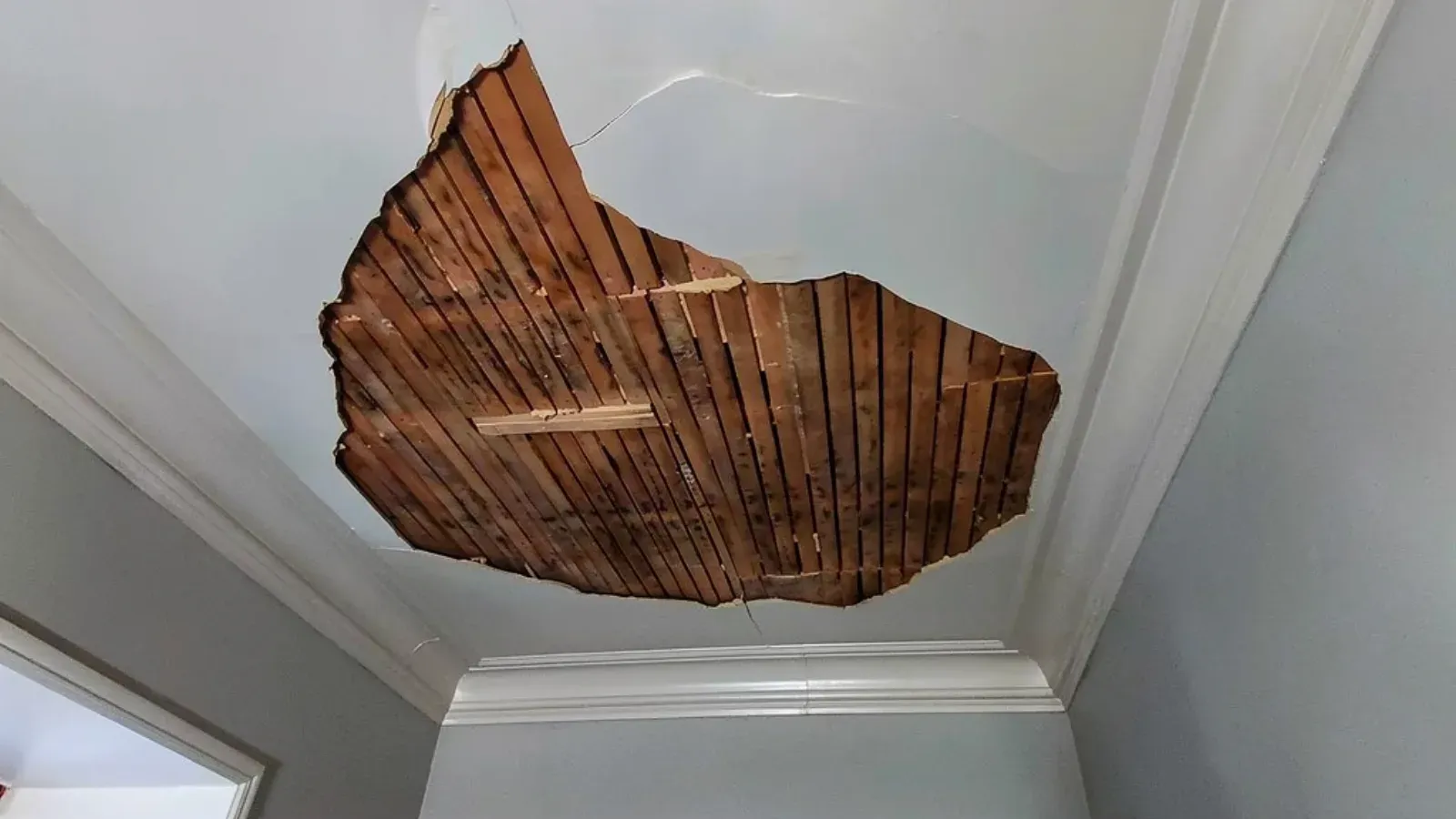
Signs you need this
- • Fine, spiderweb cracks radiating out from a ceiling corner or door frame, the kind that keep coming back after a coat of paint.
- • A ceiling or wall section that has separated from the wood lath behind it and sags or gives slightly when pressed, a sign the plaster's keys have broken.
- • Crumbling, powdery plaster at a corner or along a baseboard in a pre-1900 room, sometimes with old wallpaper or paint layers flaking off with it.
New Bedford Drywall & Plaster assesses whether original plaster can be saved or needs to come out. Sound plaster with surface cracking gets stabilized: loose sections are secured with plaster washers, cracks are reinforced, and the whole surface is skim-coated smooth. Plaster that has failed, where the lath keys have broken and the ceiling or wall is no longer structurally attached, gets removed and replaced with drywall hung to match the surrounding finish. In historic County Street and downtown properties, New Bedford Drywall & Plaster leans toward preserving and skim-coating original plaster wherever it’s structurally sound, since replacing it changes the wall’s character and can run against district expectations.
This service is for owners of County Street historic-district homes, the pre-1900 whaling-merchant mansions near the Rotch-Jones-Duff House, where original lime plaster is part of the building’s character. It is for owners of pre-1940 lath-and-plaster triple-deckers and mill-worker two-families in the West End and Far North End, where the original walls and ceilings have never been converted, and for renovators and buyers of downtown properties within the Whaling National Historical Park’s cobblestoned core, where the plaster is original building stock and often protected by district guidelines. It also fits landlords who want cracked plaster stabilized economically, set against owners doing a fuller renovation who would rather convert a room to drywall and be done with the maintenance.
Materials & standards
Products & materials we use
- USG Sheetrock
- National Gypsum Gold Bond
- plaster washers
- joint compound
Standards & codes we work to
- Massachusetts State Building Code (780 CMR)
- ASTM C1396
- GA-214 finish levels (Level 4/5)
- EPA RRP (pre-1978 lead-safe)
What the terms mean
- lath and plaster
- plaster keys
- plaster-to-drywall conversion
- skim coat
- historic-sensitive repair
- crack reinforcement
- Level 4/5 finish
- plaster medallion
Options & variants
| Option | When it applies | Cost |
|---|---|---|
| Skim-coat over sound plaster | Surface cracking or texture wear, no structural separation | Lowest; a full skim and sand for a smooth, paint-ready surface |
| Patch and stabilize | Isolated loose areas where keys are partially broken | Moderate; plaster washers, crack reinforcement, local skim |
| Ceiling-only conversion | Ceiling plaster has failed but walls are sound and worth keeping | Moderate to higher; ceiling tear-out and drywall, walls untouched |
| Full room plaster-to-drywall conversion | Widespread lath and plaster failure across a room | Highest; full tear-out, new drywall, texture and trim rework |
What affects cost
- • How much of the lath's keys have actually broken versus surface cracking that can be skim-coated over.
- • Whether it's ceiling or wall work, since ceiling plaster carries its own weight and a failed ceiling is a bigger tear-out than a wall.
- • Ceiling height and access: the tall rooms typical of County Street Victorians take more time and staging than a standard triple-decker room.
- • Lead-safe containment, since almost all of New Bedford's plaster housing predates 1978 and disturbing old paint layers requires EPA RRP practice.
- • Whether trim, plaster medallions, or crown detail need to be worked around and matched, which is common in the pre-1900 County Street homes.
What to expect
- 1
Inspect and recommend
New Bedford Drywall & Plaster inspects the plaster by tapping and pressing sections to find where the keys are broken and where the surface is still sound, then gives a straight recommendation: stabilize and skim what's sound, convert what isn't, and why.
- 2
Protect and contain
The work area is contained with plastic and floor protection, with lead-safe prep on any pre-1978 painted surface being disturbed.
- 3
Re-anchor or demo
Sound sections are secured with plaster washers and reinforced; failed sections are cut out down to the framing.
- 4
Build the surface back
Conversion areas get new drywall hung, taped, and finished to match the surrounding wall or ceiling; stabilized areas get skim-coated smooth.
- 5
Finish to level
The finish is worked to the agreed level, matching the flat, hard look of original plaster or a clean modern drywall finish.
- 6
Clean and hand off
The room is cleaned and walked through with the owner, with texture and trim checked against the original.
When this isn’t the right call
- If the plaster is actively wet from a recent leak, that's water damage drywall repair first: the moisture has to be found and dried before anyone can tell what plaster is salvageable.
- If the plaster or the framing behind it shows visible mold growth and a musty smell, that's mold drywall replacement, handled with containment before any plaster work starts.
- If the plaster is sound and the only issue is old paint color or minor cosmetic touch-up, a full repair or conversion is more than the job calls for.
Frequently asked questions
Can you save my plaster, or does it always have to come out? +
It depends on the keys, the small plaster fingers that lock through the lath. If they're mostly intact, New Bedford Drywall & Plaster stabilizes and skim-coats the surface. If they've broken loose, the section has to come out and get replaced with drywall.
My house is in the County Street historic district. Does that limit what you can do? +
It usually pushes the decision toward preserving and skim-coating original plaster rather than converting, since the wall's original character matters in that district. New Bedford Drywall & Plaster will explain the option that keeps the historic surface where it's structurally sound.
Will converting to drywall look different from the original plaster? +
Drywall finished to a Level 4 or 5 smooth coat can match plaster's look closely, though very old plaster sometimes has a texture or a slight wave that drywall won't replicate exactly. This gets discussed before the work starts.
Is lead paint a concern with this kind of work? +
In most pre-1940 New Bedford homes, yes. New Bedford Drywall & Plaster follows EPA RRP lead-safe containment whenever old painted plaster is disturbed, whether it's being stabilized or removed.
How do I know if my ceiling is actually dangerous, or just cracked? +
A hairline crack is cosmetic. A section that flexes, sags visibly, or drops small pieces of plaster when tapped means the keys have failed and it needs attention before it lets go on its own.
Do you work on plaster ceiling medallions and crown detail? +
Yes, on jobs where original plaster ornamentation is present, New Bedford Drywall & Plaster works around it and matches trim profiles rather than defaulting to a flat drywall ceiling.