
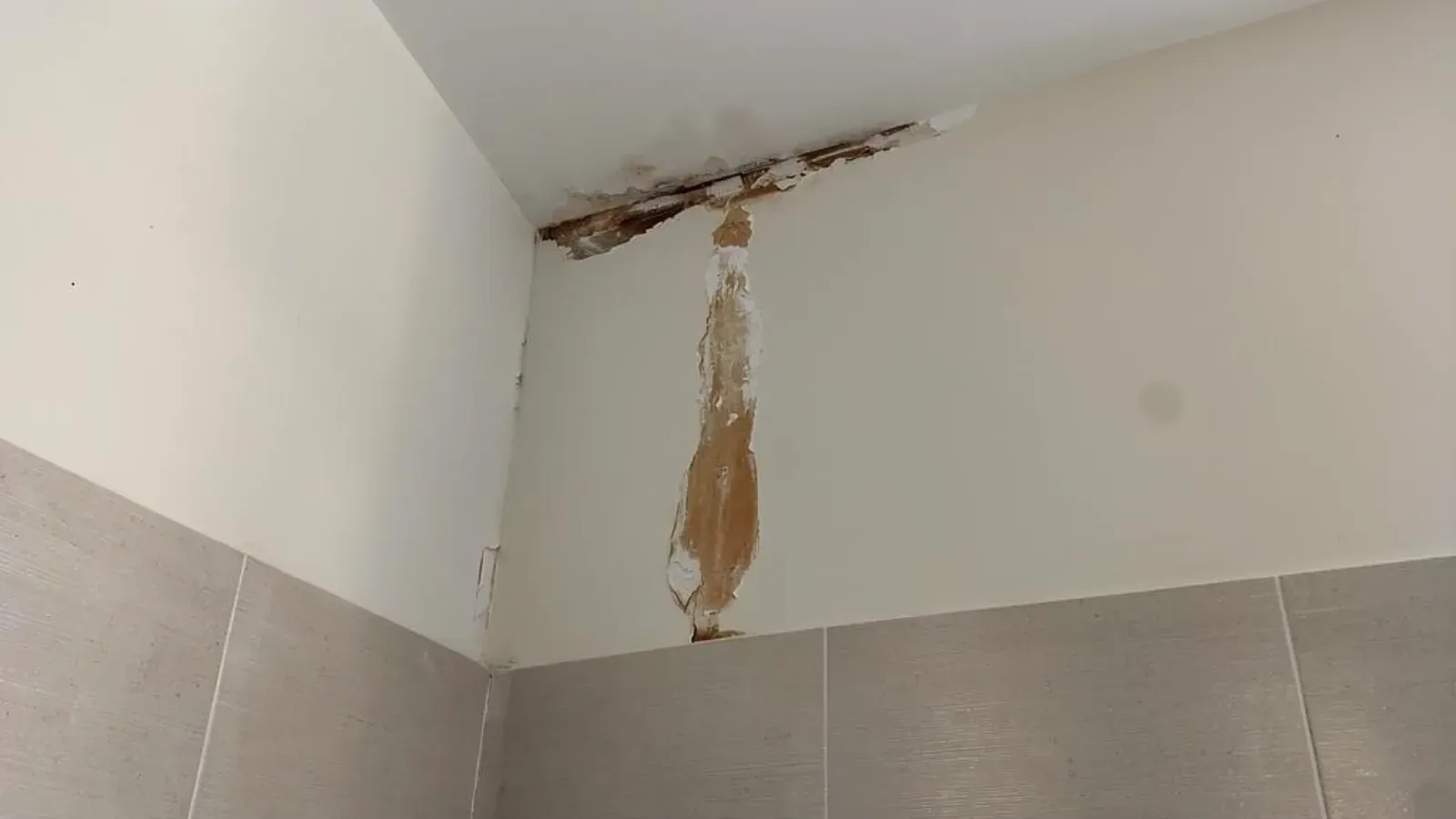
Signs you need this
- • A brown or yellow ring spreading across a ceiling, often with a soft bulge in the middle where the board is holding standing water.
- • A wall that feels cool, spongy, or gives slightly under a hand, with paint or joint tape lifting and bubbling along a seam.
- • A ceiling that starts to sag or drip hours or days after a storm, an ice dam, or an upstairs leak, sometimes long after the original event.
New Bedford Drywall & Plaster removes drywall, plaster, or ceiling material that water has soaked through, confirms the framing behind it has dried to a safe level, and rebuilds the wall or ceiling to a clean, paint-ready finish. This is restoration, not a cosmetic patch over a stain: the goal is to take out exactly the compromised board, verify the cavity is dry with a meter, and hang new material that will not telegraph a stain or start growing mold in a few weeks. On a claim job, New Bedford Drywall & Plaster works to the scope the adjuster has written and keeps moisture documentation so the paperwork holds up.
This service is for homeowners in South End homes near Clarks Cove and Fort Taber Park with century-old plumbing that bursts during a cold snap or a slow supply-line failure. It is also for landlords and property managers along the Route 18 waterfront and the low-lying streets behind the New Bedford Hurricane Barrier, where storm surge and high tide can back water up into a first floor or basement, and for owners of pre-1940 two-family and triple-decker housing citywide running original cast-iron or galvanized supply lines that fail without warning during freeze-thaw swings. Anyone mid insurance claim gets a contractor that meters moisture, documents the wet boundary, and repairs to the adjuster’s line items.
Materials & standards
Products & materials we use
- USG Sheetrock
- National Gypsum Gold Bond
- CertainTeed
- Georgia-Pacific ToughRock
- purple/mold-resistant board (M2Tech)
Standards & codes we work to
- Massachusetts State Building Code (780 CMR)
- ASTM C1396
- GA-214 finish levels (Level 4/5)
- EPA RRP (pre-1978 lead-safe)
What the terms mean
- moisture metering
- cut-and-replace
- cavity drying
- joint compound
- tape and coat
- corner bead
- stain-block sealer
- moisture-resistant board
- Level 4/5 finish
- insurance scope documentation
Options & variants
| Option | When it applies | Cost |
|---|---|---|
| Stain-only ceiling repair | A short leak that's already fixed and the board tests dry, just discolored | Lowest; stain-block seal, light skim, paint prep, little or no tear-out |
| Cut-and-replace section | A defined wet area on a wall or ceiling where the board has lost its bond | Moderate; targeted tear-out, cavity drying, new board, tape and finish |
| Full ceiling or wall replacement | Widespread saturation from a burst pipe or a flooded upper floor | Higher; more board, more finish area, texture matching if needed |
| Insurance-scope rebuild | A documented claim covering several rooms or a whole rental unit | Scoped to adjuster line items; moisture readings documented throughout |
What affects cost
- • How far the water traveled before it was found: a stain confined to one ceiling bay costs far less than water that ran down inside a wall cavity to the floor below.
- • Whether the framing and insulation are still wet and need drying time, since closing up a damp cavity is what causes a repeat failure a few months later.
- • Access and height: a stairwell ceiling in a three-story triple-decker or a finished basement below the water table takes longer than an open first-floor room.
- • The finish that has to be matched, whether that's a flat Level 4 wall or an older skim-coat or knockdown ceiling.
- • The age of the house: most New Bedford housing predates 1978, so lead-safe EPA RRP practice applies whenever old paint is disturbed, which adds containment and cleanup time.
What to expect
- 1
Find the source and meter
New Bedford Drywall & Plaster arrives, confirms the water source is fixed or identifies it, and moisture-meters the surrounding board and framing so the wet boundary is known rather than guessed.
- 2
Contain and protect
The work area is contained with plastic sheeting and the floors are protected before any cutting begins.
- 3
Cut back to sound board
The crew cuts back to sound, dry board, removing exactly the compromised section and no more.
- 4
Dry and verify the cavity
The framing and cavity are dried and re-checked with a meter, and new board only goes up once the readings drop to a safe level.
- 5
Hang and finish
New moisture-resistant board is hung, taped, and coated to match the surrounding finish level and texture.
- 6
Clean up and document
The area is cleaned and walked through with the owner, and on claim jobs the moisture documentation is handed over for the insurance file.
When this isn’t the right call
- If the wet board already shows dark spotting and a musty smell, that's mold-scope work, not a straight water repair, and mold drywall replacement is the better fit.
- If the affected surface is original lath-and-plaster in a historic County Street or downtown home and the owner wants the plaster preserved rather than torn out, plaster repair and conversion is the better fit.
- If there's no active or recent moisture and the ceiling is just cracked or sagging from age, a straight water-damage repair is more than the job needs.
Frequently asked questions
My ceiling has a stain but feels dry. Do you still have to cut it open? +
Not always. New Bedford Drywall & Plaster meters the board first. If it reads dry and the leak source is fixed, the stain can be sealed with a stain-blocker and refinished. If it reads wet, it has to come out so the cavity does not grow mold.
How fast can you get out after a pipe bursts? +
Water damage is treated as emergency work. Getting the wet material opened up and drying started quickly is what keeps a small patch from turning into a full tear-out.
Will you work directly with my insurance company? +
Yes. New Bedford Drywall & Plaster repairs to the adjuster's scope and keeps moisture readings documented so the claim paperwork is supported.
Do you dry the wall yourselves, or do I need a separate water-extraction company? +
For a contained leak, the crew dries and verifies the cavity as part of the repair. A large flood, especially from storm surge, may need a dedicated extraction company first, and New Bedford Drywall & Plaster picks up the rebuild once the structure is confirmed dry.
Why not just paint over the water stain? +
Paint over unsealed water damage bleeds back through within weeks and hides moisture that is still working in the cavity behind it. The board has to test dry and the stain has to be sealed properly before it's refinished.
My basement floods every time there's a bad storm near the harbor. Can you just keep fixing the drywall? +
New Bedford Drywall & Plaster can repair the drywall and rebuild with moisture-resistant board, but a basement that floods on every storm behind the Hurricane Barrier usually needs the water source or drainage addressed too, and the crew will say so plainly rather than repeat a patch that will fail again.